Pages

Monday, December 2, 2013

O, Little Town of Bethlehem, NH


Edward Burne-Jones, Star of Bethlehem


     Some of us -- and you know who you are --struggle to get into the spirit of the holiday season. No need to name names. But believe me, you have plenty of company.
     For many, the ghosts of holidays past are too much with us, as Dickens might suggest; so perhaps is Wordsworth’s world of “getting and spending,” as we race from Black Friday to the finish line under the lavishly decorated tree (though Camille Paglia, in her book Break Blow Burn, puts a new spin on explicating that oft-quoted phrase from the famous poem; suffice it to say the early Romantics were, well, romantic). 
     We cringe to recall the hard work and expense poured into celebratory meals gone utterly amok.  The guests who wander in ninety minutes late; the one-upmanship over cranberry relish recipes; the finicky eater who won’t touch the entrée or six of the seven elaborate side dishes.
     I’m thinking of the mother of a friend who, in a fit of despair or exasperation, threw the blasted turkey out the kitchen window, which one would assume put something of a crimp in the family gathering.  I’ve pulled a few slightly bloody carcasses out of the oven myself -- the still-frozen underbellies of overstuffed birds simply refusing to roast. Then there was a leg-pulling over a spiral cut ham that sent a sensitive relative to another room in tears. Yes, that was a fabulous holiday indeed.
     Some of us, missing those no longer at the table, can’t help but feel a little sadness creep in this time of year. Or, in the fever pitch of shopping and planning and partying, we find ourselves so overwhelmed that when the day itself arrives, we’re physically and emotionally spent. Occasionally, I’ve wanted to greet guests at the door with, “Here’s your turkey sandwich. Have a safe journey home.”
     It helps to hold in mind why we’re gathering together in the first place, often from afar, and to consider that legendary journey long ago, a difficult one, as T.S. Eliot described it in his Ariel poem, Journey of the Magi:

A cold coming we had of it,
Just the worst time of the year
For a journey, and such a long journey;
The ways deep and the weather sharp,
The very dead of winter.

     Soon we will come into winter with its weather “sharp.” We know what the Magi sought, however in Eliot’s poem, simple joy is not to be found in Bethlehem: the birth of the Savior summons in the death of the old order.  So it is with all that’s new and unfamiliar. It doesn’t hurt to be reminded that it’s frequently a tough, hard road to a desired destination, and that even mixed blessings are blessings still.
     Now it’s December. Time to catch our breath on the fast track to celebrations both sacred and secular. By seeking out a bit of tangible proof that joy exists not merely in myth, we are better able to reach the end of the holidays with our spirits lifted, not simply with the satisfaction of having lived through them for another year.  To that end, I took myself on a journey recently to our own Bethlehem, close by and with an easy highway that needs no sure-footed camel to traverse.


Bethlehem NH, 1907

      Bethlehem was first known as Lloyd’s Hill, but according to the official town website, voters resolved to change the name after the revolution, apparently to break from loyalist’s roots. Less than 3000 people live in Bethlehem proper, which in the Gilded Age became a resort for the rich and powerful, luring profiteers and presidents alike.  In the 1920s, it was the headquarters of the Hebrew Hay Fever Relief Association, as many Jewish families from New York vacationed or decided to reside in Bethlehem, finding the clear mountain air alleviated their symptoms.
     Bethlehem is quieter now, though stately old homes of more ostentatious times stand guard along the main street as you drive into the village, where shops, antique stores, and eateries await. On a recent Saturday morning, patrons walking the streets were few; a restaurant I had hoped to visit was closed. A sign in the window, illustrated with a photo of a bear, indicated that the establishment was in ‘hibernation’ until early December.  Business hours on another shop were described this way:

OPEN most days about 9 or 10
Occasionally as Early as 7, But SOME DAYS
As Late As 12 or 1.
WE CLOSE About 5:30 or 6
Sometimes as Late as 11 or 12.
SOME DAYS OR Afternoons, WE
Aren’t Here At All, and Lately
I’ve Been Here Just About All the Time,
Except When I’m Someplace Else,
But I Should Be Here Then, Too.

     At any rate, I found that business and others were open and well worth the trip.  Two antique shops satisfied my passion for searching out beautiful things at bargain prices. Ragamuffins Design offered select antiques and gently used books and clothing, along with oriental rugs, batik scarves, and hand crafted ornaments and greeting cards.  In Country Collectibles, I examined at length lovely platters, glassware, and ornate silver-plated tableware and serving pieces. From this store I came away with a delicate glass-domed plate – the perfect showcase for iced and decorated Christmas cookies.


Country Collectibles

     If you visit Bethlehem, you’ll have to stop at Local Works Marketplace, the gallery of handcrafted items and specialty foodstuffs from the Women’s Rural Entrepreneurial Network.  One room is devoted to wines, cheeses, and row upon row of small batch local preserves and condiments.  WREN members fill the store with gorgeous jewelry; healthy dog treats and cool canine supplies; pottery and original paintings; unusual cards and prints; and fragrant soaps and balms. Here I found a skein of hand-dyed wool for a friend, a great gift for someone unlikely to have sought it out for herself.


Local Works, WREN Gallery

     After a few hours of gratifying hunting and gathering, I enjoyed a stunningly good lunch of spinach-artichoke heart quiche and a bowl of tomato-roasted pepper soup at Maia Papaya, a small café next door to the post office, where some 50,000 seasonal cards are postmarked each year.  There’s still time.
    On Saturday, December 7th, the town will host the annual Christmas In Bethlehem celebration, which kicks off with the Methodist Church Bazaar and Santa’s Workshop for younger children; a cornhole tournament for those nine and up; a tour of Dawn Cottage; and a late afternoon spaghetti supper. Main Street will close at 6 p.m. for all sorts of festive entertainment, including bell ringers; several tree lightings (arrive earlier in the day and cut down your own tree at The Rocks Estate); tractor rides; the arrival of Santa himself; fireworks; and even a giant bonfire, which might warm the heart of those among us of more pagan sympathies. 
     In our own backyard, you’ll find a day of merriment and light, and of simple joys, enough to brighten the disposition of even the weariest traveler on the long holiday journey, and a reminder to be grateful for the abundance and blessings so close at hand. In Bethlehem, New Hampshire.


Some of the local libations available at Local Works.


This column appears in the December 2013 issue of The North Star Monthly. Check out their site.


Tuesday, November 26, 2013

The Snow Queen and Her Cold, Cold Heart


Even after fourteen years here in the Northeast Kingdom, the first snow that falls and sticks still comes as something of a shock. I feel as if I have to reinvent myself a bit, as a creature at home in a world of white.
     Once in that mindset, though, wrapping myself up in my long hooded coat to step outside, it’s a strangely welcoming place, as if the snow and ice aren’t so foreign after all, and the crystal covered trees along the roadways and the blanketed hills behind my house provide the backdrop to a world in some ways magical and entirely fitting.


     Perhaps if you’ve grown up in this area, the first significant snow isn’t quite as transporting. And surely we could revisit this mystical feeling in February, when, truth be told, the cold has seriously begun to wear out its welcome, even for someone as dreamy headed as myself.
     But the change in season and landscape can act as a prism through which to see your changed self as well.  I feel that way about this time of year.
     About the age of six or seven, my godmother gave me a beautifully illustrated edition of Hans Christian Andersen’s The Snow Queen.  On the cover was a picture of the haughty Queen in her elegant sleigh; on top of that picture rested a refracting lens of plastic.  If you turned the book slightly in your hands, her image seemed to float along the snowy path.
     I read and reread the story of the beautiful Queen who had no feelings, whose heart was frozen. I don’t know if at the time I thought that was a good policy for a thing as breakable as a heart, or if I cried with her at the end when she finally found love and lost it, as we sometimes do, when her tears turned to stars and then to edelweiss high on the frigid mountaintops.
     Of that book, I remember most clearly the lush paintings, tangible as photographs; the gleaming palace of ice; those muscular horses pulling the sleigh; and the Queen herself in her sumptuous cloak, adorned with furs at the cuffs and surrounding the hood – not, strangely, unlike one I now own, though hers was gleaming storybook white.


     A few years before I’d been given the book, we’d celebrated Christmas in the snowy Connecticut town where we briefly lived.  I remember the high stone wall and the treacherous roadways, a mechanical horse I’d found under the tree, and the lacy candies my mother made that year.
     She’d taken sugar and water and boiled down to an amber syrup, and carefully spun snowflake designs by letting a thin stream fall from the end of a spoon.
     Once they hardened, I held them up to the light in the windows, pretending they were stained glass. I ate a few, of course, and we tied threads through the loops and hung the rest on the tree.
     My mother will have been gone seven years this Christmas, and that loss colors the holiday. But other memories rush in, too. When I asked my mother about making the candy snowflakes, she only vaguely recalled them; I’m sure they were just one of the two dozen things she did that year to make the season special.
     But I remember. They were for me a bit of magic made out of simple sugar, a sweet lens through which a child could see the world anew.
     I’m going to make these again this year, to put on the tree. My own children are grown and gone now, and are unlikely to find the wonder I found in them. But I want to see the world that way, and myself, one more time.

Candy Snowflakes, Hearts, and Icicles

This is not a recipe to be prepared by children or daydreamers.
The hot syrup requires your full attention. Please read the recipe through before beginning, and do be very careful at every step.

3 cups sugar
1 cup water
Food color and flavorings, optional
Aluminum foil or parchment paper

     Lay out the foil or parchment paper on a counter or large cookie sheets.  Set up a shallow baking pan full of ice and water, too. This is a bath in which to dunk the bottom of the saucepan to stop the cooking of the syrup, should you find that, after you’ve removed it from the heat and are working with it, the color starts to turn too dark.
     Stir the sugar and water together in a saucepan, preferably one with high sides and a heavy bottom. Place over medium heat, stirring until the sugar is completely dissolved. Then raise the heat to high. Without stirring, allow the mixture to boil until it reaches the ‘hard-ball’ stage, 300 to 310 degrees on a candy thermometer.  This will take 9 or 10 minutes. A drop of the mixture will harden quickly and break instead of bend when removed.
     Remove the pan from the heat but keep the burner turned on in order to reheat the mixture for a moment if it starts to cool too much while you’re making the candies.  You do need the syrup to stay hot and fluid.
     If desired, carefully stir in ½ teaspoon of a flavoring extract or a few drops of food coloring. This step is entirely unnecessary, though, as the candy is delicious and the light amber color lovely without amending.
     Creating a lacy pattern from the syrup takes some trial and error.  Solid shapes, such as hearts and icicles are not difficult to fashion, and I must confess I have on occasion been content with the simplest medallions.
    Use a tablespoon of syrup to create a free-form lacy design about 2 inches in diameter. Allow a string of the syrup to fall from the tip or bowl of the spoon and simply doodle around an imagined center. I have used the end of a skewer to work some of the too-thick edges into a lacier pattern.  It’s comforting to know you can eat the mistakes.
     You might try to form a well-defined loop through which to thread a hanger or piece of string if you wish to hang the snowflakes on the tree. For the solid shapes, once they are cooling but still malleable, lift them off the foil or parchment and pierce a hold hear the edge with a toothpick or skewer. You’ll have to work fairly quickly to do this.
     Allow the candies to harden for 20 minutes or so. If storing, place in an airtight container, separating layers with parchment.


This article first appeared, in a slightly different form, in The Caledonian Record.

Sunday, November 3, 2013

Follow Your Blizzident


      Perhaps you’ve heard about the Blizzident, the newly minted must-have for those who have it all: a nifty device that promises to clean your teeth more efficiently than brushing and flossing combined, and to do so in record time.
     For $299, you can acquire your own bespoke state-of-the-art apparatus, invented, according to the marketing website, by a “worldwide interdisciplinary team of dentists, engineers, computer scientists and dental prophylaxis experts.”  You insert your custom-made Blizzident like a mouth guard and grind the teeth against it for a mere six seconds.  A plethora of tiny bristles get quickly to work and – viola – your gums and pearly whites are good to go.
     While met with some skepticism, the product has received enormous media attention and interest, and apparently consumer demand as well; the website asks for patience from those requesting additional information on the newfangled contraption.  Crafted of high-grade plastic by a 3-D printer from an impression or scan patients obtain from their dentist, the Blizzident promises fresh breath and “perfectly clean teeth.” However, it’s the “massive time saving” that’s apparently the draw for many.  According to the website Extreme Tech, converts of the new device could cut 55 hours per year devoted to dental care. 
     Imagine that! Freedom from the drudgery of brushing your teeth.
    How is it that we are so time-challenged that we begrudge the few minutes per day necessary for low-tech care of our choppers? For apparently, in this free market, there are enough people willing to spend hundreds of dollars or Euros – it’s a global initiative here -- on such a convenient gizmo.
     And what are we likely to turn our attention toward, given those extra hours per year?
     Here’s a quick look at how we divide our time currently, courtesy of New Media Trend Watch: we Americans spend roughly 4.5 hours a day watching television; 2.5 hours on-line, and the better part of an hour with a mobile device at our ear or in front of our eyes. Nearly 8 hours a day, then, we’re plugged in.


     I’m as guilty as anyone. I wouldn’t miss a few favorite shows, and occasionally the television blares on from another room, just to break the stillness in the house. I post batty photos and observations to Facebook with regularity, check e-mail nearly on the hour while working at the computer, and grab my iPhone as soon as I hear that Pavlovian ding indicating someone close has sent a text. But I haven’t reached the point of taking the phone into the bathroom. I can still tolerate a few moments of silence while brushing and flossing.
     I’m wondering if that in itself isn’t part of the (unconscious) appeal of an expensive, time-saving absurdity; not that we could make shorter work of an innocuous and already short task, but that it lessens the moments spent looking into the mirror alone with our own thoughts.   We don’t on the whole highly value moments spent quietly idling, in solitude, devoted to introspection; certainly little in society encourages us to consider those lulls in productivity worthwhile. “Time is money,” Franklin said, and we unmindfully concur.
     And it can be scary, having too much time on your hands. “I just start thinking about myself,” says Carol the waitress in As Good as It Gets, “and what good does that ever get anybody?”
     Julia Cameron, author of the acclaimed The Artist’s Way, offers a useful tool that not only empowers creativity, but helps overcome the fear of facing that time alone thinking about yourself. The practice of writing “Morning Pages”  – three longhand pages of whatever crosses the mind – can help a person ‘become acquainted” with not only positive thoughts but also the darker side of consciousness – the fear, anger, and pettiness we all possess.  The not so attractive face we might not want to see staring back from the page, or from the mirror.  The face of the inner self we need to look upon closely, to live that examined life worth living.


        For many years, I’ve kept a journal, most recently more off than on. Morning Pages as Ms. Cameron describes them are quite different, though; I find them more challenging. They’re not a record of events, and not, as she says, meant to be artful, but an opportunity to meet your shadow self, to tap into your creative energies, and to – each day -- take one step closer to discovering your bliss, what really moves you in life. 
     The practice takes a good twenty or thirty minutes to do well.  There is no time-saving Blizzident equivalent for cleaning out the cobwebs of the psyche.


This column appears in the November 2013 issue of The North Star Monthly. Check out their site:  www.northstarmonthly.com 


Friday, October 4, 2013

Artifacts


    A friend from graduate school has been scouring top to bottom her gorgeous antebellum South Carolina home in preparation for putting it on the market.  She and her husband have gone a little OCD about the endeavor, she says, and this morning she’s sent me a note warning of the dangers of overdoing it.
   Many years have passed since she and I could share leisurely lunches at one another’s kitchen tables.  Anyone who spends time with me these days knows there’s very little risk I will “overdo it” when it comes to housecleaning.  Myopia has its benefits.
     But I am on a mission to de-clutter. The basement is so empty it echoes (full disclosure: I hired men to help with this).  And while the loft over the garage remains a terrifying maze of boxes and abused furniture, I am chipping away at closets, going through the large plastic tubs into which much of the detritus of our modern life has fallen.     
     The strategy of tossing junk into stackable containers has worked for the last six years or so, but eventually, one must sort and purge.  Less mucking out than patient mining, the task can yield its unexpected nuggets of gold.


     A folder of papers I’d inherited from my Aunt Ginny turned up in one of those plastic tubs stowed in a spare bedroom closet, along with a potpourri of notebooks, papers, and out of focus drugstore reprints one of my daughters left behind after heading to college.  Inside the folder I found my paternal grandfather’s will and an accounting of his estate; a substantial, glossy photocopy of my father’s discharge papers; and a number of formal portraits. 
     There’s one of my father at age ten or eleven, and several of my aunt as a young woman: smiling broadly after her graduation from nursing school, and lining up against the façade of a stately brick building with three dozen other students all in white.  In another, she’s clearly served as a maid of honor; post-ceremony, she stands beside her good friend, who wears cat-eye glasses and holds a cigarette in her free hand.
     And then, there was an envelope: unaddressed, three inches by seven. Inside, an invitation to my grandparents’ wedding, a tiny card announcing my aunt’s birth, several miniscule newspaper clippings, and what is perhaps the last letter my grandmother, Elsie Buel, ever received, written by her mother, Ada Louise Tyre.

                                                                                                              Monday Eve
                                                                                                                                 8 30

My dear Elsie,

     Just a few lines, to tell you we arrived home all OK at 7 pm.  Had a cup of tea at Alma’s, all the rest had ice cream, but me. I did not want any.  Mrs. S staid all night with me. She was delighted with her trip or I should say visit; she thinks you are a wonderful hostess and housekeeper, I agree with her. You surely did it all up fine. Everybody was fine, and your dinner was fine! I thank you for all your kindness to us all.

     I will think of the nice time when I am alone here in the eve.  My thoughts will all be happy of all my visits with you all. I have been busy all day, went down town  . . .in the morning then had a lot of work when I came home. My coat came at noon but I have packed it up to send back. We don’t like it, and they did not put the buttons and loops on.  I don’t know where I will get one now. Maybe I will go to Asbury later on, after Mrs. S gets there. This pen will hardly write so guess I will have to hurry along. Well. Willetts forgot the bag with the bread so Alma had to stop in one place and get some rolls. 

     Now I hope John’s cold is better, and that you were none the worse for your work. We all think the kiddies were fine, and I was very proud of you all. Ada V. was a real little lady, and John too was very good. We talked about it going home in the car.  Now I must send a few lines to Mame and Fanny but not tonight.  I am too sleepy, take care don’t get any more cold, dress warm, the children too. I will send those things later. 

    Now will say good night
  lots of love to all,
    again thanking you
          lovingly
               Mother

Excuse this scribbling


     A two-cent stamp sent the letter -- posted Tuesday, October 28, 1930 -- on its way to my grandparent’s home in Wilmington, Delaware, from Toms River, New Jersey. Ada V. was my Aunt Ginny, and John is my father. Alma was Elise’s sister; the forgetful Willets was Alma’s husband, and Fanny and Mame were stepsisters. 
     Those undisclosed items promised to follow might have arrived, but were almost certainly not enjoyed or put to use.  Elsie’s brief obituary, a mere 128 words, preserved on one of the yellowed clippings, says she died November 8th of a brain abscess, “which developed from an abscess of the ear, which started last Sunday.” She was 42 years old.

                                                                Elsie with Ada Virginia
                                                                                  
     Two more clippings were also enclosed in the delicate envelope. In one, a tiny inch of newsprint, a single line describes a bridal luncheon given by her future mother-in-law. In another only slightly larger, a concise report documents the couple’s “quiet wedding” on a Wednesday afternoon in April 1913 at Elsie’s parent’s home.  The unattended bride wore a travelling suit of steel-colored French poplin with a matching hat, and carried white roses.  Following an informal reception where Elsie received “a large number of beautiful gifts,” the newlyweds honeymooned in Atlantic City.
     Time has left this little trove too fragile to handle repeatedly.  The clippings are dry and crumbling as the wings of desiccated insects, and in just a few hours of examination, I’ve aggravated the envelope’s fraying fold. I’m grateful that in my zeal to clean, these misplaced treasures -- the wedding invitation from a century ago, the notices of what constitutes the public moments of our private lives, and that poignant letter – were not lost.
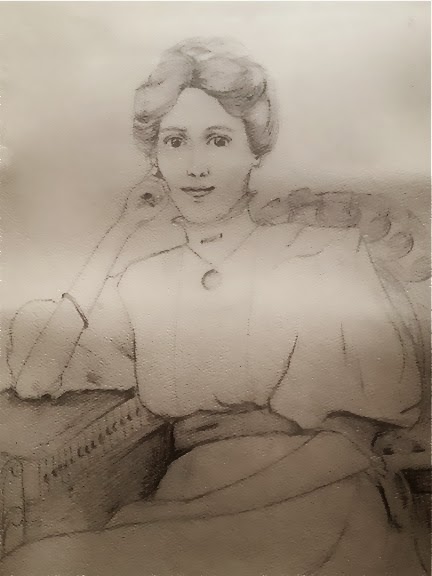
     I knew of Elsie and her early death, of course, and have wondered what effect that might have had on my father, who was only six at her passing. As with all of our beloveds gone too soon, something of a mythology spins about and shapes the sorrow. I do know that the woman who eventually replaced her in the household lacked much of anything resembling human warmth. As a teenager, I found a photo of Elise seated in a wicker chair, and drew her portrait in pencil.  Faded now, the eyes remain impossibly large and dark, her wrist slender as a child’s, as I captured without comprehending a perfected image of what was lost.
     Of all the newly recovered items, it is the letter that stays with me most. I suppose my grandfather kept it and the envelope’s other contents safe among his personal papers.  I find myself imagining what it might have meant to Elsie to receive such loving and appreciative thanks. Maybe too she needed the reassurance her mother gave her that indeed everything “was fine.”


     As in the case of that simple sketch I crafted as a kid, whatever we read – novel, text, the unending stream of e-mail – we interpret in the context of our own pain and joy. It’s not possible for me to read that final letter without thinking about the last conversation with my own mother. She had become ill seven years ago this autumn. Usually, I’d see her during the day, but one evening, something told me to just run over. 
     I’d brought with me an album of photos of the kids, and I sat beside her hospital bed as we looked through it together.  It was an exceptional evening, a few days before Christmas; after long weeks of suffering, she appeared free of both pain and care.  Her smile was as bright and the smooth oval of her face as lovely as I’d ever known them to be. Though I had the privilege of being with her when she passed the next morning, it was the short hour we spent the evening before I hold most dear, when everything seemed, for want of a better word, fine.
     I too will think of the nice time, as did Elsie’s mother, when I am alone here in the eve.


This column appears in the October 2013 issue of  award-winning The North Star Monthly.  Visit their site:  THE NORTH STAR MONTHLY


Monday, September 9, 2013

On the Cover of the Rolling Stone


     The ancient Israelites understood the power of the image. While we interpret the second commandment prohibiting the crafting of “graven images” as an ordinance against fashioning objects of worship, several scholars believe that it might have been more far reaching. In some eras and regions, the creation of any sort of likeness seems to have been discouraged.  Furthermore, according to Professor Carl S. Ehrlich, the Greek philosopher Plato opposed “certain artistic pursuits . . . since they distracted from the search for truth.” 

     Today digital photograph is our universal art form of choice; we live in a world awash in images of all sorts. Seeing is believing. We document and share on social media everything from our breakfast cereal to the exchange of wedding vows to appendectomy scars.  Before his most recent self-destruct, half of the city of New York was ready to vote into office a man who’d texted strangers photos of his private parts.

     Bombarded with pictures, we get a rush from the hypnotic onslaught and require more and more.  And having seen it all, we might dismiss the sway of any single one, even something truly gripping and unique. We’re above it.  We’re rational beings, after all.

     That’s what they’re counting on, the media manipulators who grab onto our hearts and minds and wallets through our eyes, that we refuse to acknowledge the influence a powerful image can have on our emotions and perceptions. Consider for a moment how some images become lodged in the mind: the logo for Arm and Hammer, for example, or the font used on a bottle of Febreze, to say nothing of a few unforgettable scenes from Pulp Fiction or The Exorcist.


Lord Byron as a teenager. 
Or perhaps not Lord Byron at all.


     In August, Rolling Stone Magazine published “Jahar’s World,” an in-depth profile by Janet Reitman of Dzhokhar Tsarnaev, the younger of two brothers accused of carrying out the Boston Marathon bombing that killed three and injured scores, many grievously.  The article attempts to explain how “a charming kid with a bright future” became a “monster.” In soft-focus, Jahar, identified as “The Bomber” and staring guilelessly into the camera, appears on the magazine’s cover.

     It is an arresting photograph, an apparent self-portrait taken from Tsarnaev’s Twitter profile. Whatever toying with shadow and the play of light might have done, the result is affecting and effective.  Its appearance on newsstands brought about an uproar, in Boston and beyond.

     The editors of the Rolling Stone responded, yet failed to address the heart of the controversy. They focused on the content of the article itself, which they rightly declare as falling “within the traditions of journalism and the Rolling Stone’s long standing commitment to serious and thoughtful coverage of the most important political and cultural issues of our day.”

     They continue: “The fact that Dzhokhar Tsarnaev is young, and in the same age group as many of our readers, makes it all the more important for us to examine the complexities of this issue and gain a more complete understanding of how a tragedy like this happens.” 

     However, that isn’t the issue. I read of no objections to the article itself, which seems to this reader very thorough in its coverage if ultimately incomplete in the portrait it provides. This is not the author’s fault; the story of the younger Tsarnaev brother is still unfolding. The anger arose from the art.  The decision to use Jahar’s image on the cover – an exalted, coveted position occupied by celebrities -- was roundly criticized.

     But even more, I think it was the sort of image the editors employed that so inflamed the outrage: indistinct and dreamy, a portrait of visual poetry that lends a tragic, romanticized air to the subject.  The Jahar on the Rolling Stone cover is beautiful and damned. He’s Lord Byron with a bomb – mad, bad, and dangerous to know.  

     What’s taken place with this cover is the crafting of the glamorization we claim to abhor: the potent mingling of taboos – the marriage of sex and violence.  Witness the fanatical young women who attended Jahar’s court appearance and who maintain a number of “Free Jahar” social media sites, one of which claims some 80,000 followers.

     It was disingenuous to suggest, as banter on the airways after the publication did, that the cover art was simply meant to illustrate the article inside.  If that were its primary purpose, it would have appeared along with the text. Its chief function of course was to sell magazines, which indeed it did. The August issue of Rolling Stone sold twice the typical number of copies. Editorially, then, adorning the cover with a dreamy photo of the tousle-haired, beautiful boy was brilliant.  Google “Boston bomber” and that likeness is among the very first to appear.

     The young man who killed my husband had also been a beautiful boy.  His high school yearbook photo accompanied one of the many articles in the Hartford Courant’s Pulitzer Prize winning coverage of the 1998 shootings at the Connecticut Lottery. Even in my anguish, I remember thinking what a handsome kid he had been, with his dark eyes and hair, his unclouded expression, a picture of American promise.  I am the mother of a son. I could imagine another woman’s pride in and love for the adored child still somewhere inside the troubled young adult.

     That yearbook photo was of course genuine; it caught the young man as he was, at one moment in time. At another point, he would have appeared otherwise, captured perhaps on a security camera some years later, with a shaved head, brandishing a bloodied knife or his altogether efficient Glock.

       Both representations could be called accurate. But both are incomplete, and neither is quite the truth.  The cover portrait of the Boston bomber with its softened features in high, flattering contrast is in effect the flipside of a gruesome shot of the carnage he’s accused of committing. The later we would immediately decry.  Stripped of context, the hazy photo is repugnant as well, a different sort of terror porn.

     How many will read the Rolling Stone article and discuss the argument it supports, that young Jahar was at heart a normal kid “failed by his family” and in part society? It’s an excellent piece, and one could contend that number, whatever it is, is too small though clearly far more than might have been, had not the provocative photo been so cleverly utilized. Perhaps his trial  -- and his growing fan base  -- will force us to examine the twists and turns of the path he walked toward the marathon finish line.

     In all likelihood, though, and all too soon, the lessons of “Jahar’s World” will be largely forgotten.  The controversy over the cover photo will, too, fade.  But the striking image of the beautiful boy carries with it all the heartbreak and eroticism it needs to live forever.  


This column appears in the September 2013 issue of The North Star Monthly, which has won awards for its features and photography. Check out their site: